
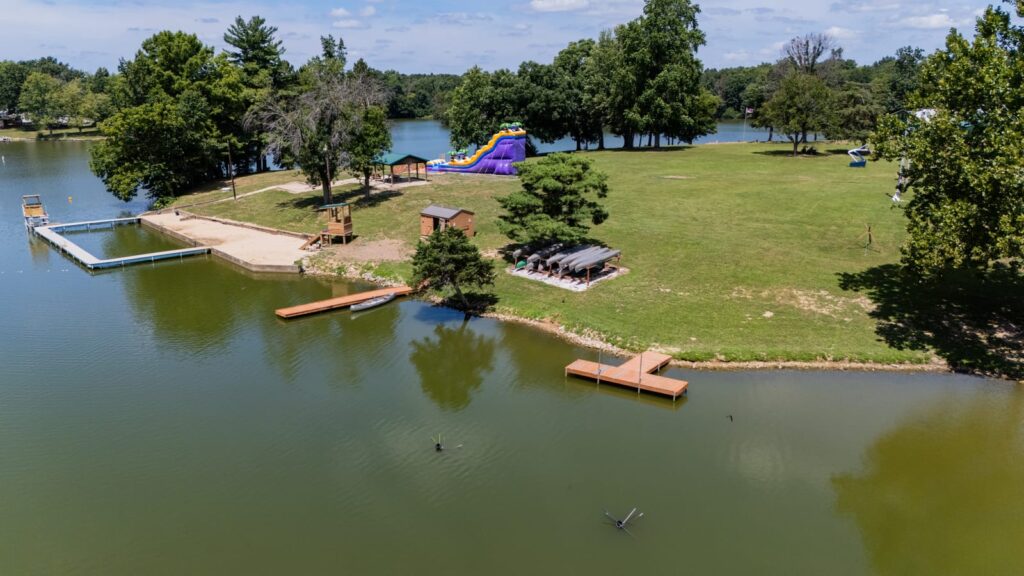
Some places hold three generations of a town’s summers. Ten minutes south of Jacksonville, at the end of a gravel lane called 4-H Club Lane, Western Illinois Youth Camp has been doing exactly that since 1948 — and this July we got to fly straight through the middle of it while camp was in full swing. Kids waving from the gaga ball pit, canoes cutting across Lake Jacksonville, the brand-new waterslide towering over the field: this is what 78 summers of community effort looks like from the air.
Jacksonville keeps finding new uses for its old buildings. Downtown, the 1870 Gillham House reopened this summer as Jacksonville Transfer Company, an antique mall and custom furniture shop we toured with an FPV drone.
A Camp Built by Its Community — Literally
Western Illinois Youth Camp opened on July 16, 1948 as the Western Illinois 4-H Camp, serving kids from 23 counties across west-central Illinois. The first campers slept in tents on the lakeshore. Everything you see in these photos came after — and almost none of it was built by contractors.
The founding charter was ambitious in that plainspoken postwar way. The camp was established “to provide grounds, housing, facilities, and accommodations for 4-H Clubs and Rural Youth camps, meetings, shows and activities… to promote and advance cultural, horticultural, conservation, and civic interests of Western Illinois.” That reach was real: the original camp region covered 23 counties, from Morgan and Sangamon out to Adams, Knox, Peoria, Hancock, and Calhoun. And here is the detail most people never learn — the camp has never owned this ground. Since 1948 the campgrounds have been leased from the City of Jacksonville, which is part of why the town’s stake in this place has always been more than sentimental.
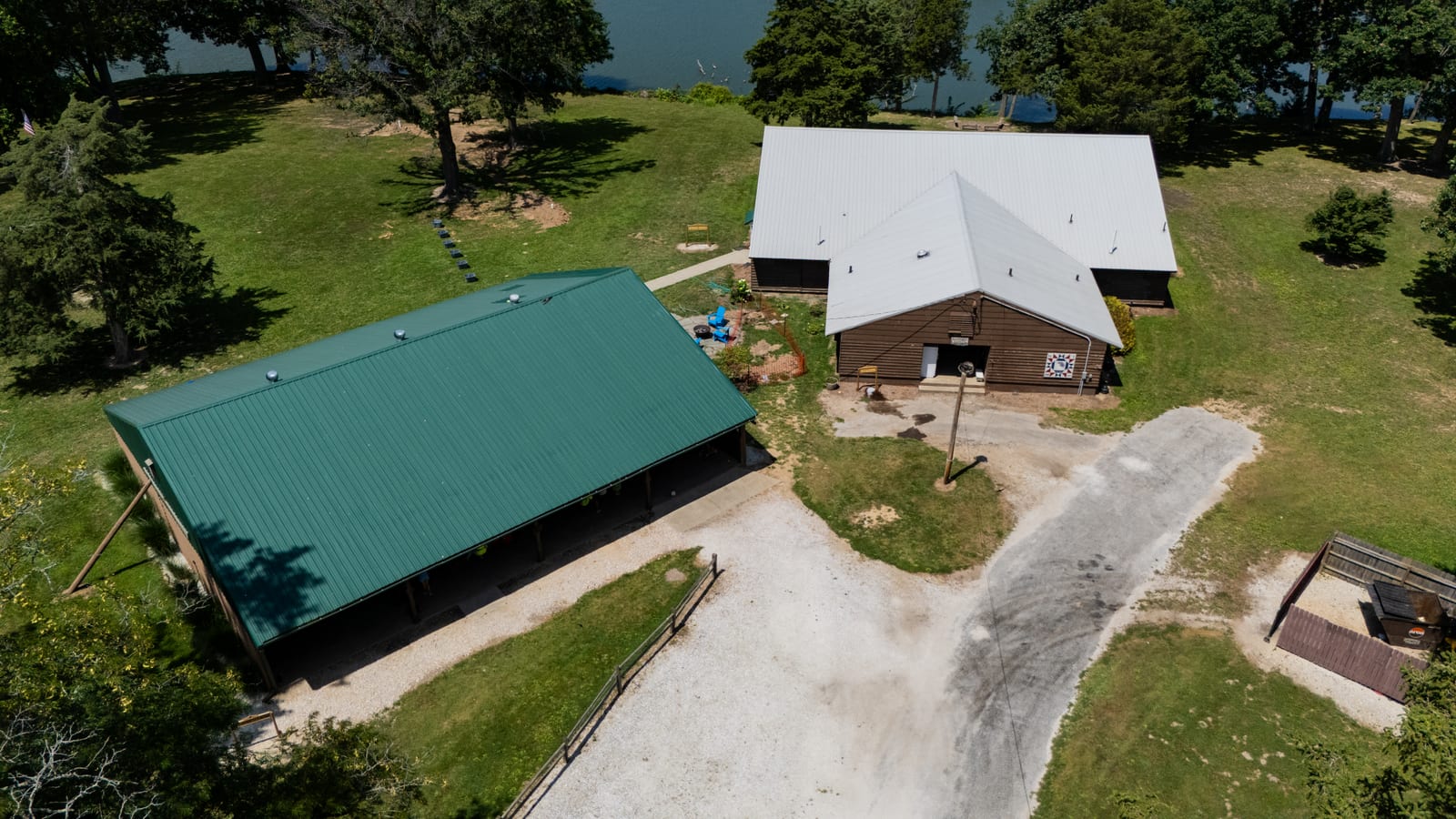
The buildings went up through volunteer work days: the Registration Cabin in 1952 along with the Dining Hall and Recreation Hall that still anchor the camp today. Parents, farmers, and local tradesmen showed up on weekends with tools and put a camp together board by board. In its heyday the camp hosted 150 to 200 campers a week — and those campers grew up, had kids, and sent them down the same gravel lane.
Read the grounds as a construction timeline and you can watch a community build a camp one weekend at a time:
- 1950 — the Dining Hall.
- 1952 — the big year: the Canteen (later reworked into the Registration Cabin), the Recreation Hall, the North Campus girls’ cabins and shower house, the first three South Campus boys’ cabins, the Nature Cabin (now the maintenance shed), the cooks’ cabin that became the Krell Cabin, the Director’s House, and the camp’s own water plant.
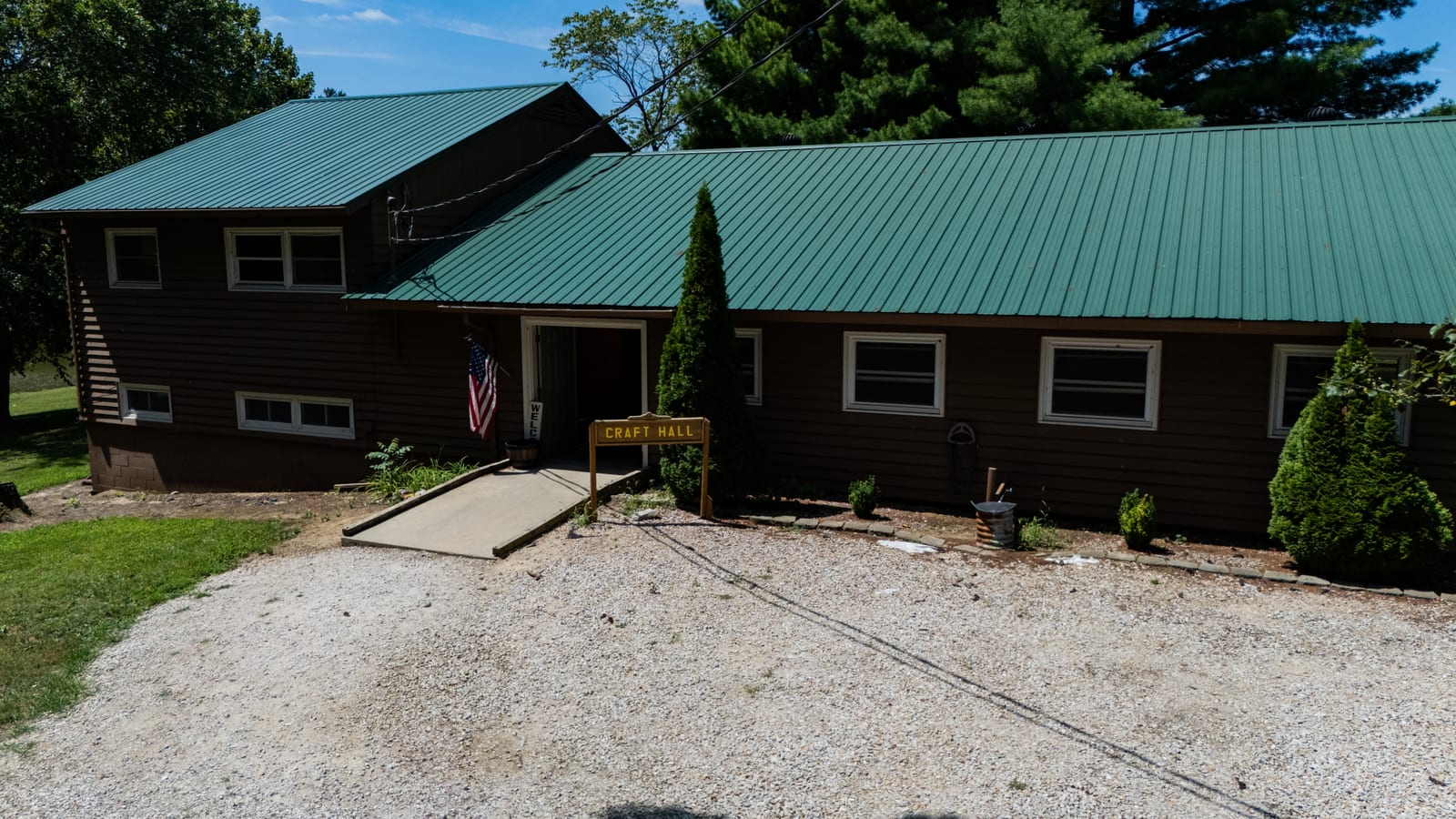
- 1965 — Craft Hall, the South Campus shower house, and the rest of the boys’ cabins.
- 1975 — a fireplace room and garage added onto the Director’s House.
- 1980 — the Beach Shed, rebuilt again in 2012.
- 1986 — the concrete retaining wall and platform along the waterfront you can see in our aerial shots.
- 2007 — county water finally replaced the camp’s own 1952 water plant.
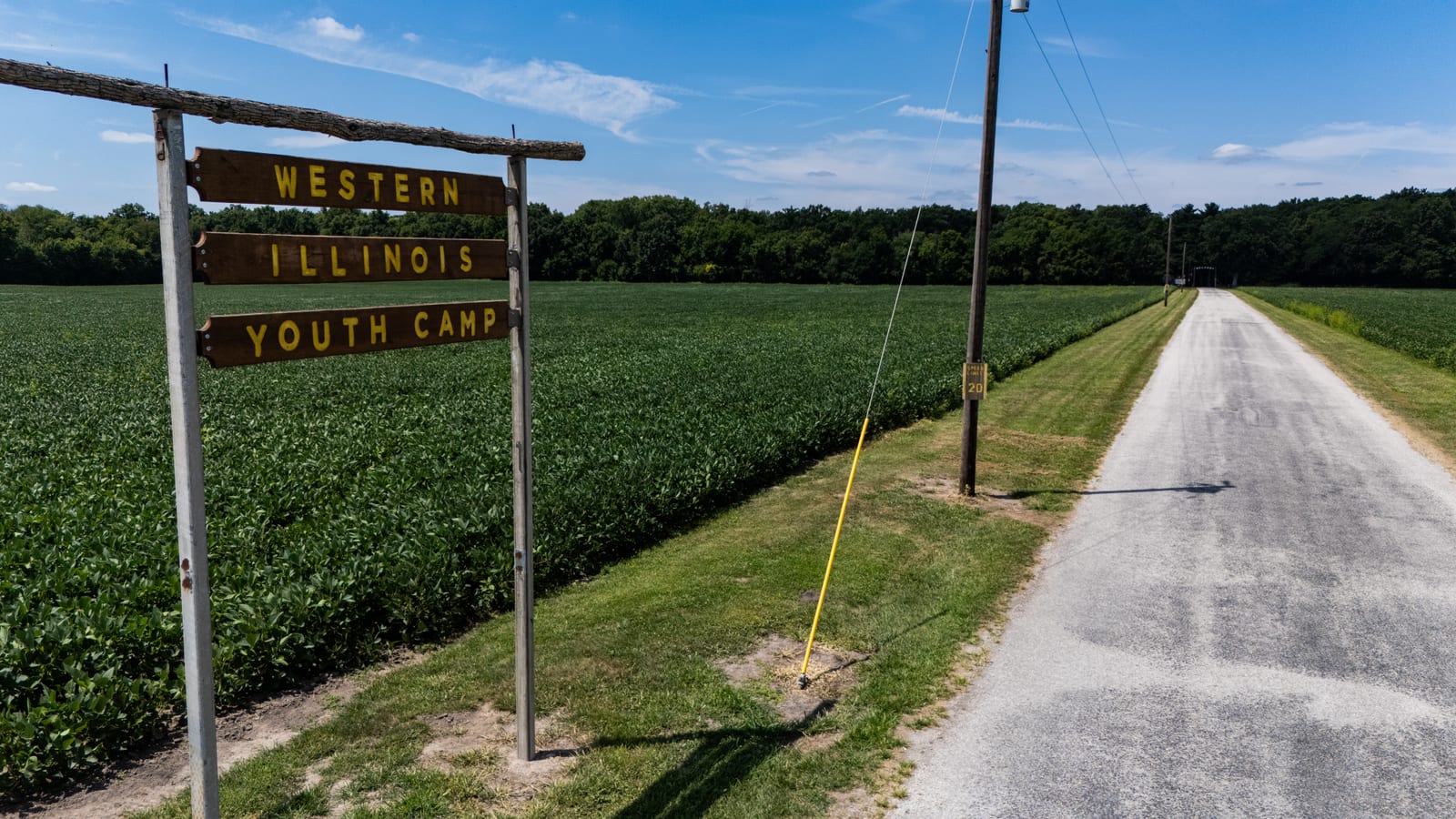
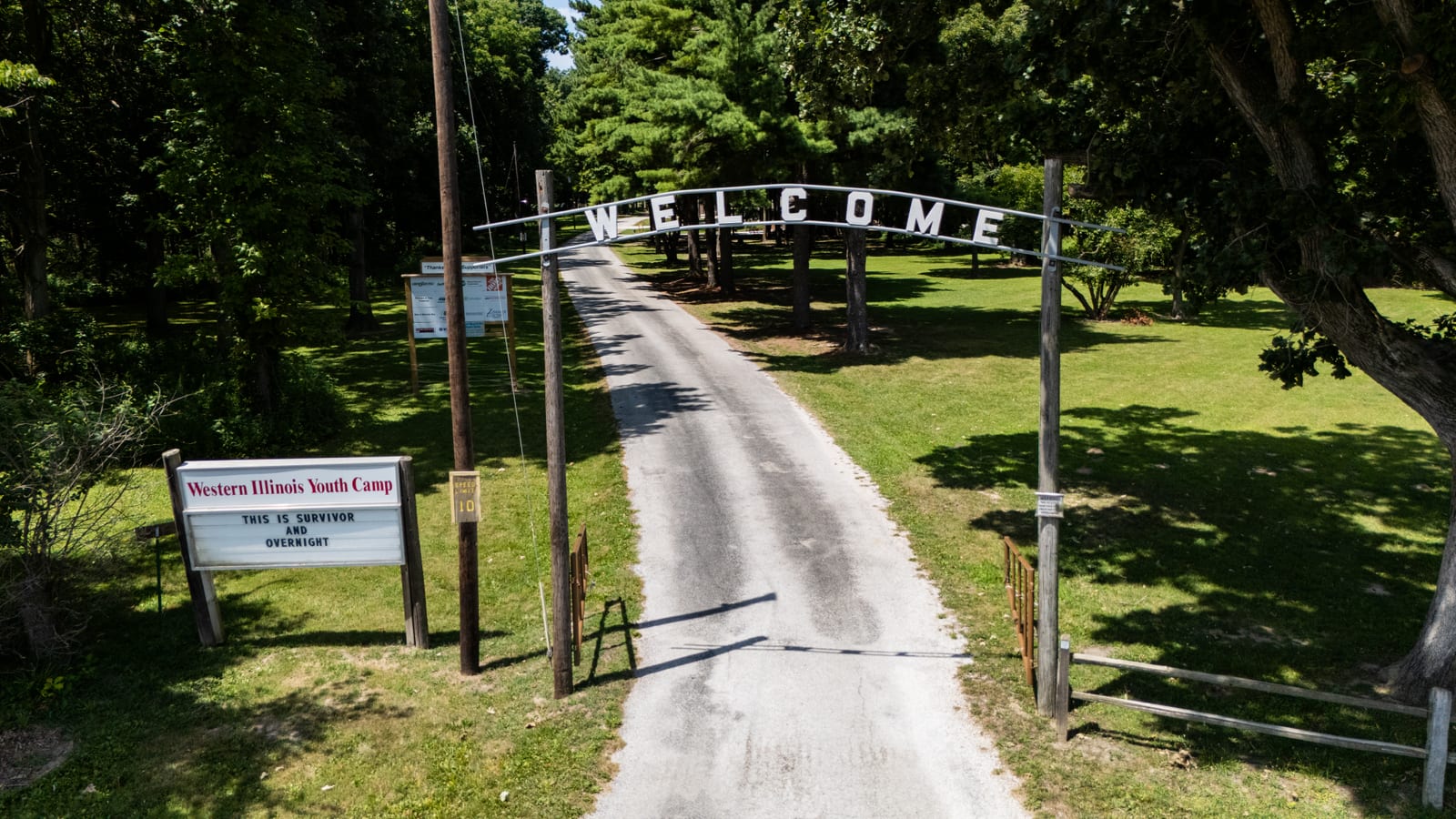
That lane is worth a moment: our drone caught the wooden camp sign standing alone against the soybean fields, then the white WELCOME arch appearing over the drive as the woods open up. Three generations of campers have watched that arch come into view from a backseat window. It still means the same thing it meant in 1948: summer starts here.
Wagon Wheels, Bug Juice, and the Bell
Every camp builds its own vocabulary, and WIYC’s is worth writing down. Campers were sorted into Wagon Wheels — gathering spots scattered across the grounds with names like Annie Oakley and Buffalo Bill — and each group met at its wheel to run through the day’s activities. The wheels themselves are gone now, but a lot of grown adults in this county still know which one was theirs.
By the back entrance of the Dining Hall hangs the camp bell. It could be heard from every corner of the property, so it did most of the talking: time to switch activities, time for the “trotters” to come set the tables, time to eat — often with Kool-Aid or lemonade that nobody ever called anything but bug juice. When weather came across the lake, the bell sent everyone to shelter in Wentz Hall. The bell is quiet these days, which is its own small piece of history.
Other landmarks come and go and come back. The Red Bridge — painted barn red so it could be spotted from anywhere — was the shortcut across the cove and the best place on the property to fish at dawn or dusk; it was eventually torn down past repair and has since been replaced with a new bridge. A rope bridge once ran from the North Campus cabins out to the north trails. Behind the North Campus shower house sat a rifle range used into the early 1990s, stocked with BB guns donated by Daisy.
Inspiration Point faces the open water and has hosted plenty of weddings, including those of two past camp directors. Campers once sat on its wooden benches for Red Eagle ceremonies, Evensong, and the Sunday Morning Watch service during Family Camp. Between Craft Hall and the Recreation Hall, the Recreation Field has absorbed decades of softball, kickball, volleyball, and the gloriously chaotic Silly Olympics — and the camp’s totem pole was rescued out of storage and stood back up near the flagpole where campers could enjoy it again.
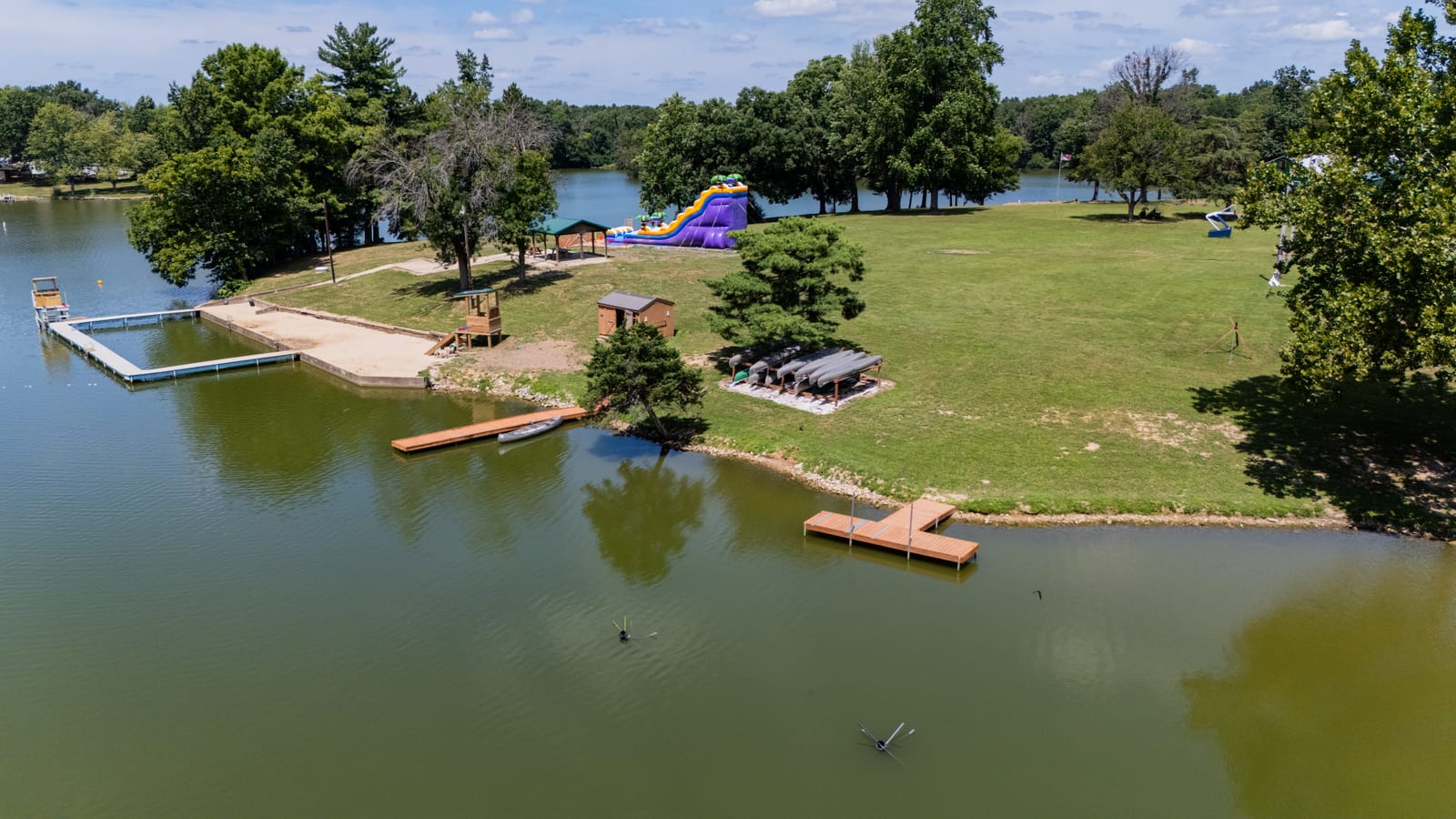
The waterfront has always been the center of gravity. Past the swimming and canoeing, campers have swamped canoes in the cove, gone logrolling in the evenings, dived for clam shells, and chased a greased watermelon across the water before eating it. Anyone under 16 still has to pass a swim test before heading out to the deep area, the floating dock, or the canoes.
And a good share of what is out there today was built by campers who came back as adults. The Low Ropes Challenge Course in the pine forest — the seven “pods” our drone threads between — went in on a grant in 2003 and still runs teamwork and communication exercises for youth campers and for outside organizations renting the grounds. The archery range was renovated in 2010 by a Boy Scout Eagle project, and the benches and firepit at South Council Ring were rebuilt by another one in 2012.
Every Kind of Camp
The gates here have opened for a great deal more than 4-H. For years, Stewardship Week brought grades 3 through 6 out each fall, with the Illinois Department of Natural Resources and University of Illinois Extension running exhibits, speakers, and mini-clinics on conservation, ecology, fishing, flora and fauna, geology, and water — a full day of learning how to enjoy the outdoors properly.
The Diabetic Camp out of Peoria, sponsored by the American Diabetes Association and local hospitals, used WIYC through the mid-1990s. It brought its own doctors, nurses, and dietitians, while the camp’s waterfront staff, cooks, and program staff stayed on to help. Clinics ran from calorie counts and healthy snacks to giving shots and wound care, for campers from six years old through high school — with plenty of time left over to just go be a kid outside.
The Winchester High School band held a week-long camp here every August, working marching routines with breaks to swim or crash in the cabins. Camp Care-A-Lot served underprivileged youth from around the region for years. Camp Courage still serves campers with physical and mental challenges. There have been Performing Arts Camps that put on a show at the end of the week, and Family Camps where descendants of the families who helped establish the place came back for a weekend of food, activities, and old friendships.
The original overnight programs were Adventure Camp for ages 8–12 and Teen Camp for ages 12–16. In recent years the program has shifted with the community toward day camp for younger school-age kids plus one or two overnight weeks — and the grounds stay busy April through October with weddings, family reunions, retreats, and parties.
The Town That Saved Its Camp
For roughly its first fifty years the camp ran under the University of Illinois Extension Service. A seasonal crew — a director, program staff for arts and crafts, recreation, waterfront and nature, three cooks, and a camp nurse — worked from late May through mid-August, while one caretaker kept the grounds and buildings up year-round and lived in the Director’s House. Teenagers aged 15 to 17 came up through the ranks as Camp Staff Trainees, or CSTs, learning the job before they were old enough to hold it. Nearly everything then was an overnight camp: campers arrived Sunday afternoon and went home Friday morning.
Every long story has a hard chapter. When the University of Illinois Extension Service reduced its involvement in 2001, the camp lost its institutional parent and struck out on its own as the independent, nonprofit Western Illinois Youth Camp. A decade later the camp was in real trouble — more than $20,000 in debt, with aging buildings and an uncertain future.
What happened next is the best thing about this place. A group of local Kiwanis members and 4-H camp veterans — people who had grown up on these grounds — committed to bringing it back. They asked Jacksonville and Morgan County for help, and the community answered: donations, in-kind services, materials, labor. The debt was cleared. The buildings were repaired. The camp lived.
Today there’s a sign along the entrance lane that reads “Thanks to our Supporters”, lined with the names of local businesses and donors. We photographed it from the air, and honestly it might be the most important picture in the gallery — because it explains every other one. This camp exists because its town refuses to let it go.
The camp was $20,000 in debt and fading. Jacksonville’s answer: not this camp, not on our watch.
What Summer Looks Like Here in 2026
Fly through the camp today — as our FPV drone does in the video above — and you’ll see a camp in the best shape it’s been in for decades. The 2026 season runs eight weeks of day camp at $210 per camper per week, with an overnight week, a 1:8 camper-to-counselor ratio, certified lifeguards on the waterfront, and camp director Tanell Meado leading a staff that keeps the whole thing humming.
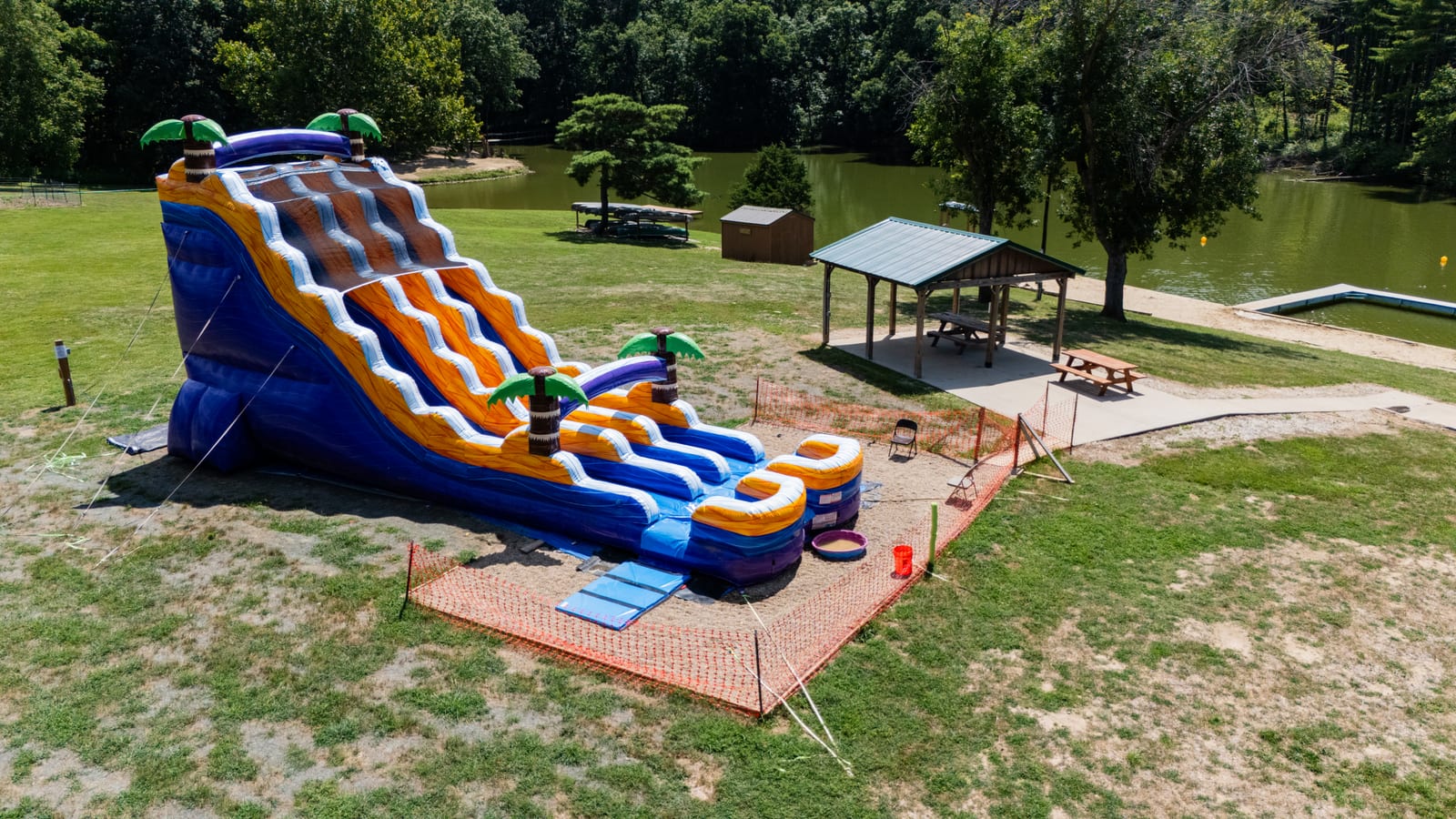
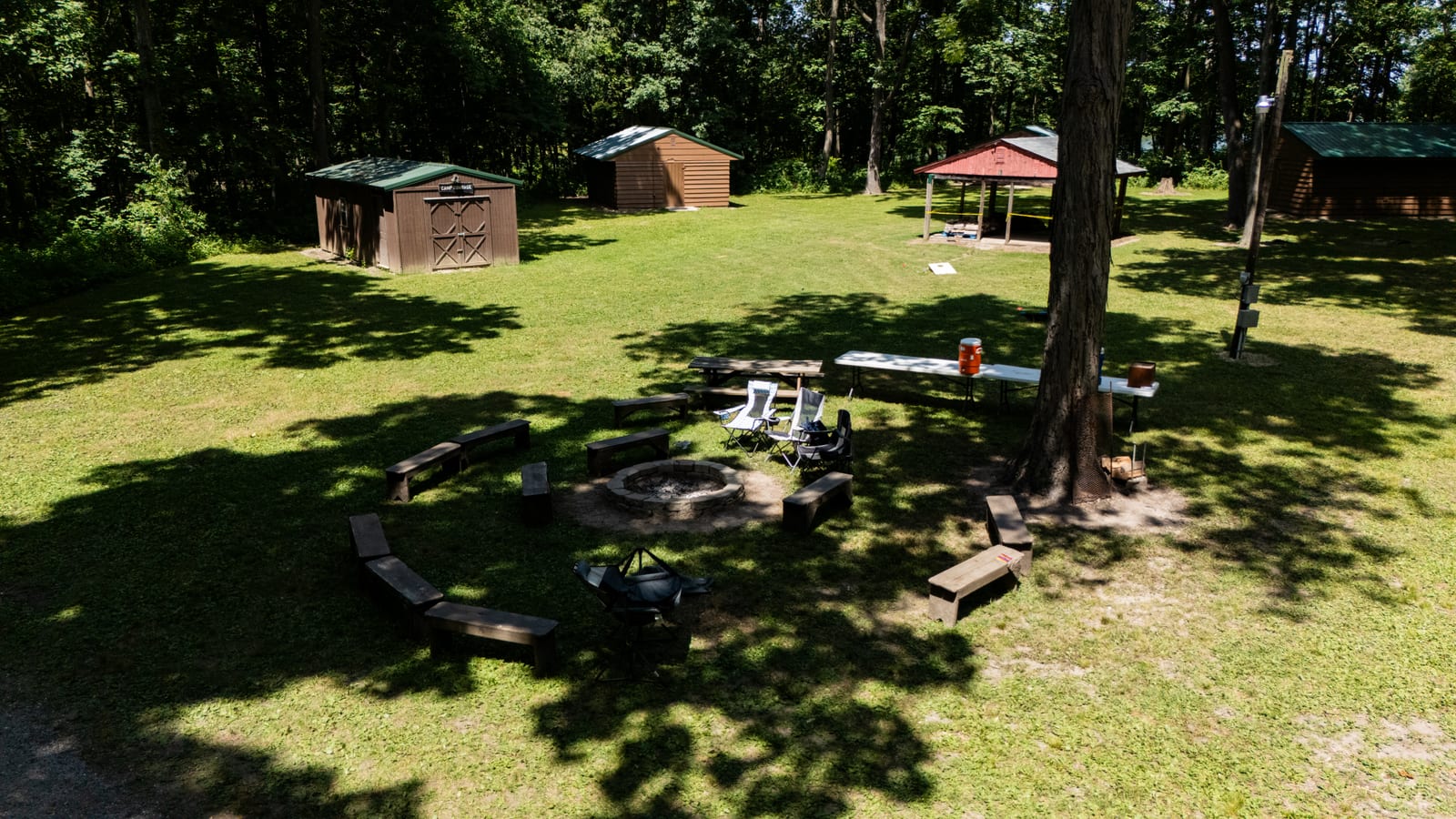
The headliner this year is the brand-new inflatable waterslide — you can’t miss it in the aerial shots, all purple and orange with palm-tree towers, used daily whenever weather allows. Around it: the swim docks and floating platform on Lake Jacksonville, canoes and fishing along the shore, the archery range tucked into the woods, the gaga ball pit under the oaks, the council fire ring, and the pine grove where the obstacle course winds between the trunks.
And the refresh keeps rolling. This year volunteers repainted every one of the bunk cabins, the fishing and waterfront areas got upgrades of their own, and a full rebuild of the shower house is next on the project list. That is what stewardship looks like at a volunteer-run camp: every season, something on the grounds gets a little better than the year before — and you can see it in every frame of the fly-through.
Just as important is what you won’t see: screens. Phones and electronics stay home, and for a week at a time kids get the kind of summer their grandparents had — sunburned, worn out, and completely present. Specialty weeks carry the camp’s inclusive streak forward, like Camp Courage for campers with mental and physical challenges, continuing a tradition that has also included Camp Care-A-Lot for underprivileged youth. This is a camp that has always believed every kid deserves a summer.
The Aerial Gallery
Nine drone photographs of the grounds, buildings, and waterfront at Western Illinois Youth Camp. Click any photo to view it full-screen.
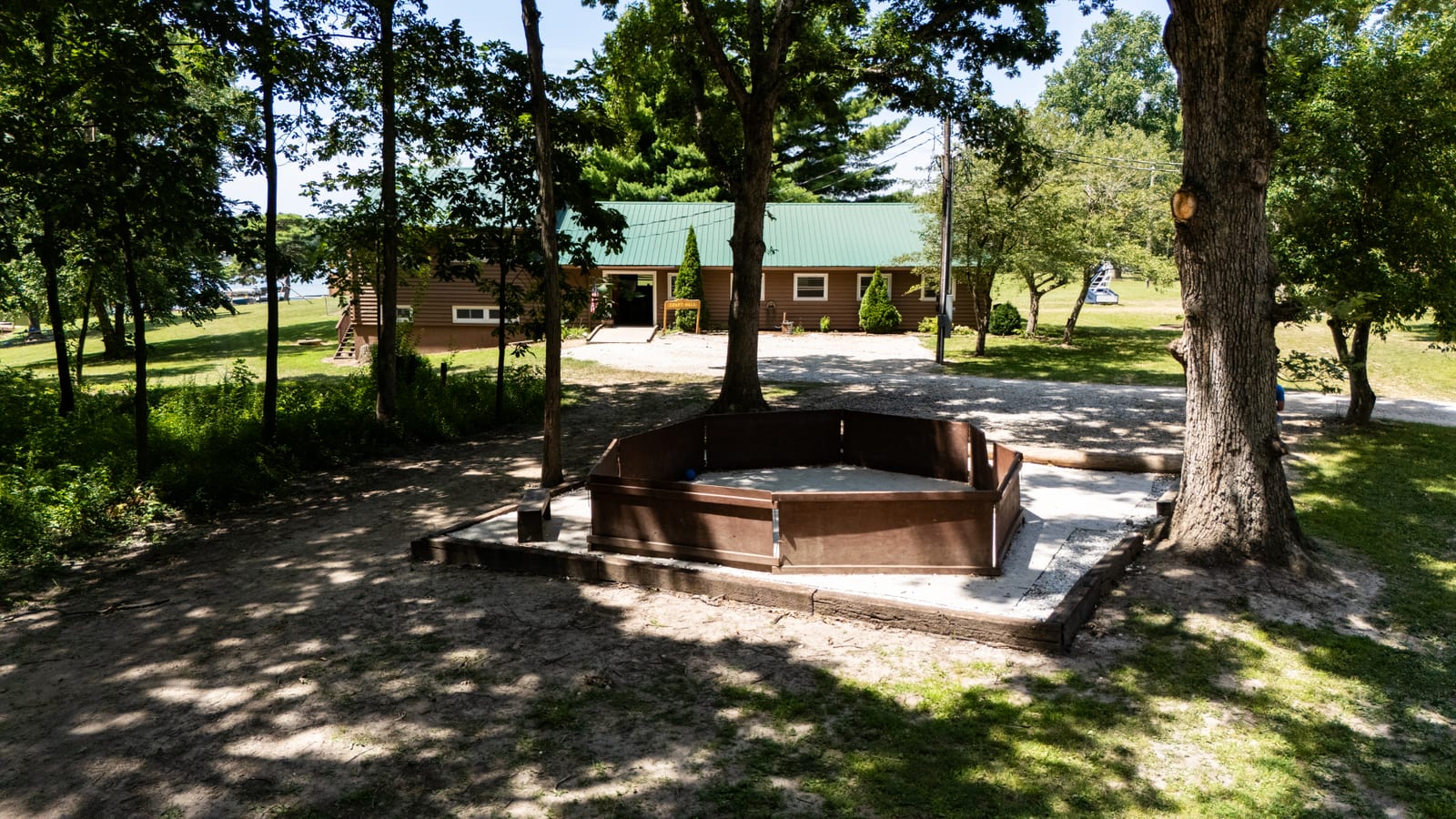
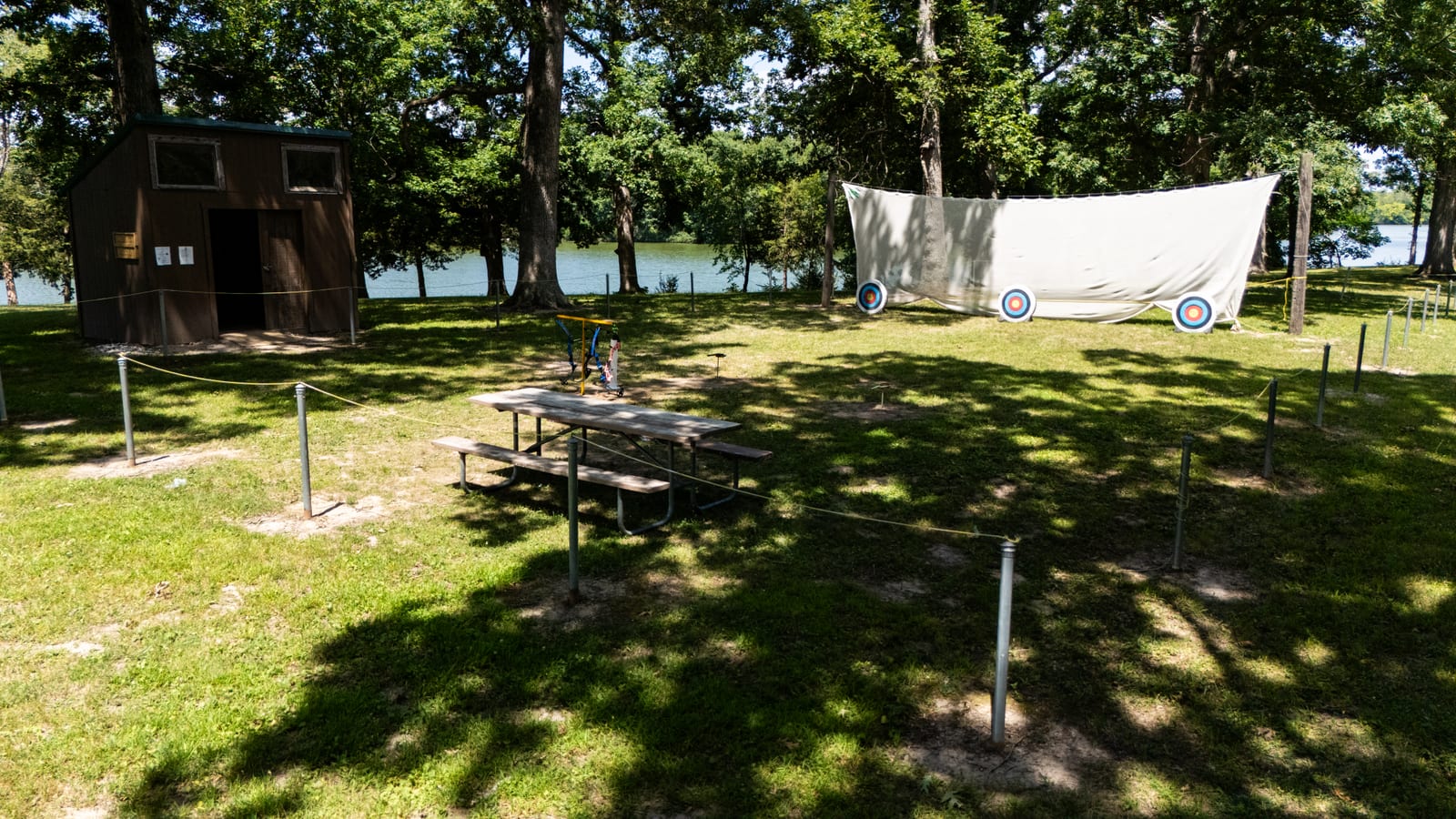
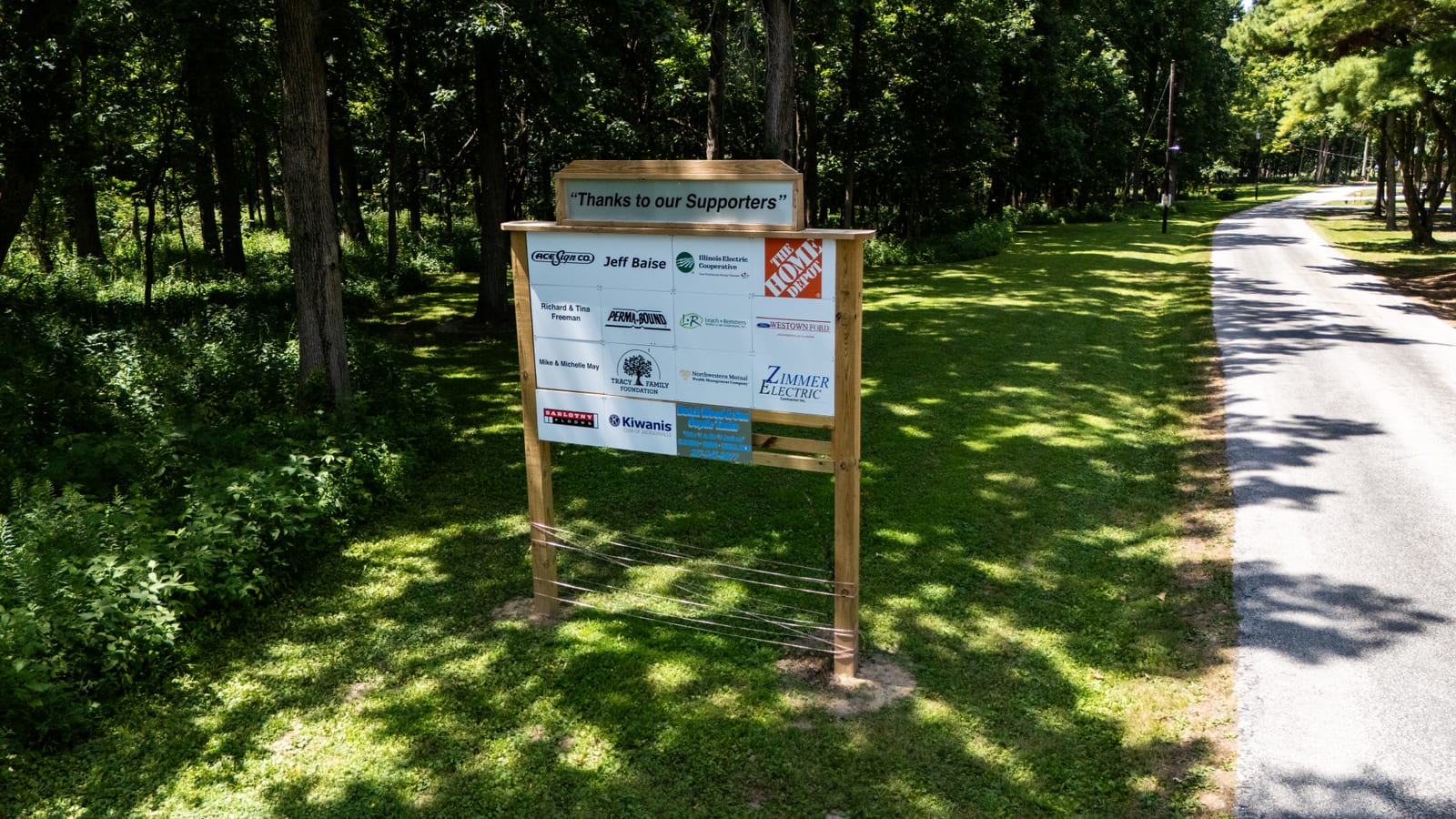
“The Western Illinois Youth Camp dedicates its efforts and resources to providing services and programs in a healthy environment that will successfully impact the education, physical, mental, social, and emotional growth of all program participants.” — WIYC mission statement
How to Support Western Illinois Youth Camp
The camp is a 501(c)(3) nonprofit run entirely by volunteers — no paid officers, no overhead empire. Camp fees and rentals cover most of the bills, and community generosity covers the rest, which means every way of supporting the camp goes straight into the camp:
Send a camper. Registration for the summer day camps (and the overnight week) is online at hisawyer.com/western-illinois-youth-camp, with a payment plan available. Details on the camp’s site at wiyc.net.
Book the grounds. Weddings, receptions, reunions, and retreats run April through October — a lakeside venue where your rental fee funds kids’ summers. Schedule through Hamilton’s at the Lake at (217) 675-2720.
Donate. Gifts are tax-deductible and can be mailed to Western Illinois Youth Camp, PO Box 48, Jacksonville, IL 62650, or start the conversation at contactourcamp@gmail.com. In-kind donations of materials and skilled labor have built this camp for 78 years and are always welcome.
Follow and share. The camp posts on Facebook — every share puts the camp in front of a family who didn’t know it was here.
Why We Flew It
We point our drones at the places that make this corner of Illinois worth calling home — the Big Eli Ferris Wheel, the Morgan County Fair, and now the camp where Jacksonville kids have learned to swim, paddle, and aim a bow for 78 summers. An FPV fly-through does something a brochure can’t: it puts you in the middle of camp while it’s happening, moving at kid-speed past the cabins and out over the water.
For organizations like WIYC, footage like this works hard — it shows parents exactly what their kids’ summer looks like, gives donors proof of what their support built, and gives the camp a library of media for years of posts, packets, and grant applications. If your organization, venue, or business has a story best told from the air, our drone photography and video services cover everything from FPV fly-throughs to full aerial campaigns.
Want Aerial Video Like This for Your Organization?
FAA-certified FPV and drone photography across Jacksonville, Springfield, and Central Illinois. Fast turnaround, flat-rate pricing, and editing that makes every frame count.
Licensed & insured • Part 107 certified • Based in Jacksonville, IL
Western Illinois Youth Camp FAQ
What is Western Illinois Youth Camp?
Western Illinois Youth Camp is a nonprofit summer camp and retreat center on Lake Jacksonville, about ten minutes south of Jacksonville, Illinois. Founded on July 16, 1948 as the Western Illinois 4-H Camp, it has given west-central Illinois kids an outdoor, unplugged summer for more than 75 years. Today it is operated by the Western Illinois Youth Camp, a 501(c)(3) run by an all-volunteer board.
Where is Western Illinois Youth Camp located?
The camp sits on the shore of Lake Jacksonville at 2244 4-H Club Lane, Jacksonville, IL 62650 — roughly ten minutes south of town, surrounded by farm fields and lakeside woods. Look for the wooden camp sign and the WELCOME arch over the gravel lane in our photos.
How much does summer camp cost and how do I register?
For the 2026 season the camp offers eight weeks of day camp at $210 per camper per week, with one week including an overnight option and a payment plan available through the registration system at hisawyer.com/western-illinois-youth-camp. Campers are dropped off after 7:30 a.m. and picked up by 5:30 p.m., with a 1:8 camper-to-counselor ratio and certified lifeguards on the waterfront.
What do campers do at Western Illinois Youth Camp?
Swimming and waterfront time on Lake Jacksonville, the brand-new inflatable waterslide, canoeing, fishing, archery, gaga ball, campfires, crafts in Craft Hall, and plenty of unstructured outdoor play — phones and electronics stay home. Specialty weeks like Camp Courage serve campers with mental and physical challenges, part of a long camp tradition of making sure every kid gets a summer.
Can you rent Western Illinois Youth Camp for weddings or events?
Yes — the grounds, pavilions, and halls are available April through October for weddings, receptions, family reunions, and retreats. Events are scheduled through Hamilton’s at the Lake at (217) 675-2720, and rental revenue helps fund the camp’s youth programs.
How can I support Western Illinois Youth Camp?
Register a camper, book the grounds for your event, or donate — the camp is a 501(c)(3) nonprofit (donations are tax-deductible) run entirely by volunteers, so gifts go straight into the camp. Mail donations to Western Illinois Youth Camp, PO Box 48, Jacksonville, IL 62650, or reach out at contactourcamp@gmail.com. Following and sharing the camp’s Facebook page helps too.