
Need hands-on help nearby? Explore our Illinois service areas.
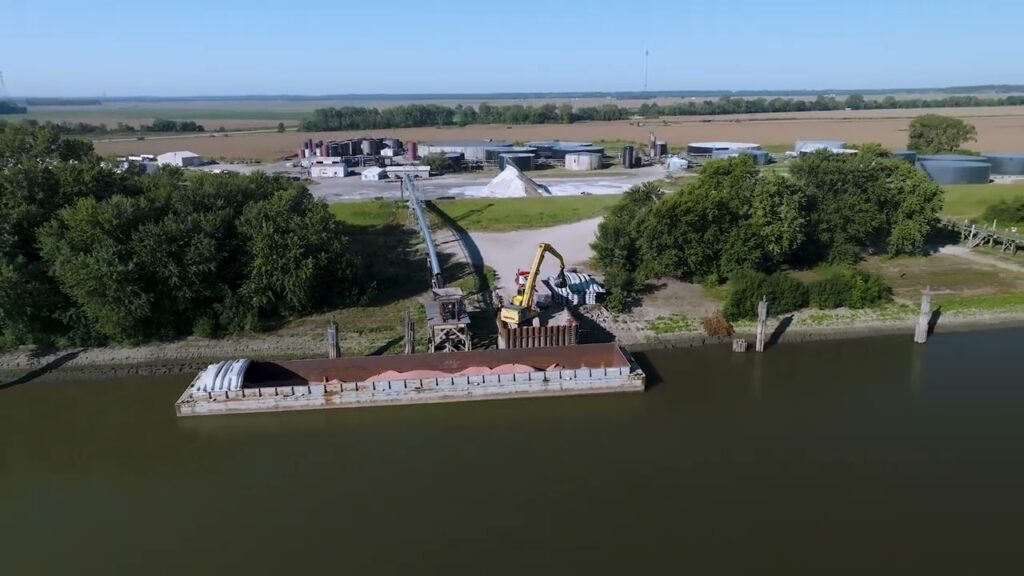
River terminals are the quiet workhorses of the Illinois economy. Grain, aggregate, asphalt and steel move up and down the Illinois River every day, and almost none of it gets photographed, because the work happens over water, around heavy equipment, in places you can’t safely stand with a camera. That’s precisely where a drone earns its keep. The footage above documents asphalt being removed from a barge at the river terminal in Meredosia, Illinois, and it’s a working example of what industrial drone inspection and documentation look like when they’re done for operators, not for social media likes.
The Job: Asphalt Off a Barge, On the Record
Unloading material from a barge is a coordinated dance between the vessel, the dock and the machinery working between them, and from the shoreline, you can only ever see a slice of it. From the air, the entire operation reads at a glance: the barge against the terminal, the equipment cycling material ashore, and the full site context around it. One flight produced a visual record that would be genuinely difficult to assemble any other way.
- Full-site context: wide aerials placing the barge, dock and terminal infrastructure in a single frame, the shot every project stakeholder actually wants first.
- Operational close-ups: orbits over the working equipment showing exactly how material moved off the vessel.
- A dated record: timestamped footage of the operation as it happened, ready for project files, reporting or promotion.
- Zero interference: the crew never stopped working. The drone stayed clear of the operation while the camera did its job.
Why Industrial Operators Are Putting Drones Over Their Sites
Search interest in industrial drone inspection has climbed steadily for a simple reason: the alternative methods are slow, expensive or dangerous. Getting a camera over water, up a conveyor structure or across an active laydown yard traditionally means lifts, ladders, boats or scaffolding, plus the people to operate them and the liability that follows those people around. A drone removes nearly all of it.
- Nobody leaves the ground. The riskiest part of visually checking industrial infrastructure has always been putting a human somewhere precarious. A drone takes the human out of the equation.
- Operations keep running. No shutdown windows, no halted equipment. Flights are planned around the work, not instead of it.
- Minutes, not days. A site that takes a morning to walk can be flown and documented before the first coffee break.
- Repeatable angles. The same flight path flown monthly builds a like-for-like visual timeline, the backbone of progress documentation.
The expensive part of documenting industrial work was never the camera. It was the downtime, the equipment and the people you had to put at risk to carry it.
Documentation vs. Inspection: Two Jobs, One Flight
These terms get used interchangeably, but operators should know the difference, because the same flight can often deliver both. Inspection is about finding problems: surveying a roof, a stack, a conveyor or a hull for wear and damage before it becomes a failure. Documentation is about proving work: recording that an operation happened, how it was executed, and what the site looked like before, during and after.
For a terminal, that documentation has hard business value. It supports contract and billing records, gives insurers and stakeholders an unambiguous account of how material was handled, settles disputes before they start, and (not incidentally) makes for the kind of footage that wins the next contract. Very few terminal operators can show a prospective customer what their unloading operation actually looks like. The ones who can, stand out.
What Industrial Drone Services Look Like in Practice
Flying an active industrial site is not the same discipline as shooting real estate. Water, moving machinery, overhead obstructions and working crews all shape the flight plan, and the deliverables are defined before takeoff, not discovered in the edit.
- Scoping: what needs to be captured, for whom, and in what format: video record, stills, progress series or all three.
- Compliance: every flight under FAA Part 107 by a certified remote pilot, with airspace checks and any required authorizations handled before arrival.
- Site coordination: flight paths planned with the crew on the ground so the drone never dictates the pace of the operation.
- Delivery: edited video, raw footage and stills packaged for the project file, the boardroom and the marketing team alike.
It’s a different flavor of the same craft we apply elsewhere: the discipline behind a one-take facility tour through a Taylorville dealership or documenting a tree crew working heavy equipment in Jacksonville. The subject changes; the planning, safety and usefulness of the footage don’t. If your operation runs on barges, rail, tanks, conveyors or acres of yard, our drone video services were built for exactly this kind of work.
The retail version of that discipline is a one-take interior flight like our FPV tour of Jacksonville Transfer Company @ The Gillham House, an antique mall and reclaimed-wood furniture shop in an 1870 house.
Put a Camera Over Your Operation
FAA-certified industrial drone documentation across central Illinois: terminals, plants, yards and job sites. Flat per-project pricing, deliverables defined up front, and zero disruption to the work below.
FAA Part 107 certified • Industrial & commercial sites • From the team at Elevated Ideas
Good To Know
Industrial Drone Documentation FAQs
What is industrial drone documentation?
It is the use of drones to create a dated visual record of industrial operations: unloading, construction, demolition, maintenance or site conditions. Unlike inspection, which hunts for defects, documentation proves what happened and how: valuable for project files, billing support, insurance, stakeholder reporting and marketing.
Can a drone legally fly over an active terminal or job site?
Yes, when operated by an FAA-certified Part 107 remote pilot with proper airspace clearance and a flight plan coordinated with the site. We check airspace, secure any needed authorizations and plan flight paths with your crew before arriving, so the flight is both legal and predictable.
Does the operation need to shut down for the flight?
No, and that is one of the biggest advantages. Flights are planned around the work in progress, keeping the aircraft clear of equipment and personnel while the operation continues at full pace. The Meredosia barge unloading in this post was filmed without pausing the crew for a single minute.
What deliverables come from an industrial drone shoot?
Typically an edited video, high-resolution stills and the raw footage, packaged for however your team needs to use them: project records, client reporting, safety review or promotion. For ongoing projects we can refly the same route on a schedule to build a consistent progress timeline.
How does drone inspection compare to traditional methods on cost?
Dramatically favorably. Traditional visual access means lifts, scaffolding, boats or rope teams, plus the labor and liability that come with them. A drone captures the same views (often better ones) in a fraction of the time with no one leaving the ground. Projects are quoted flat, per project, before we fly.