
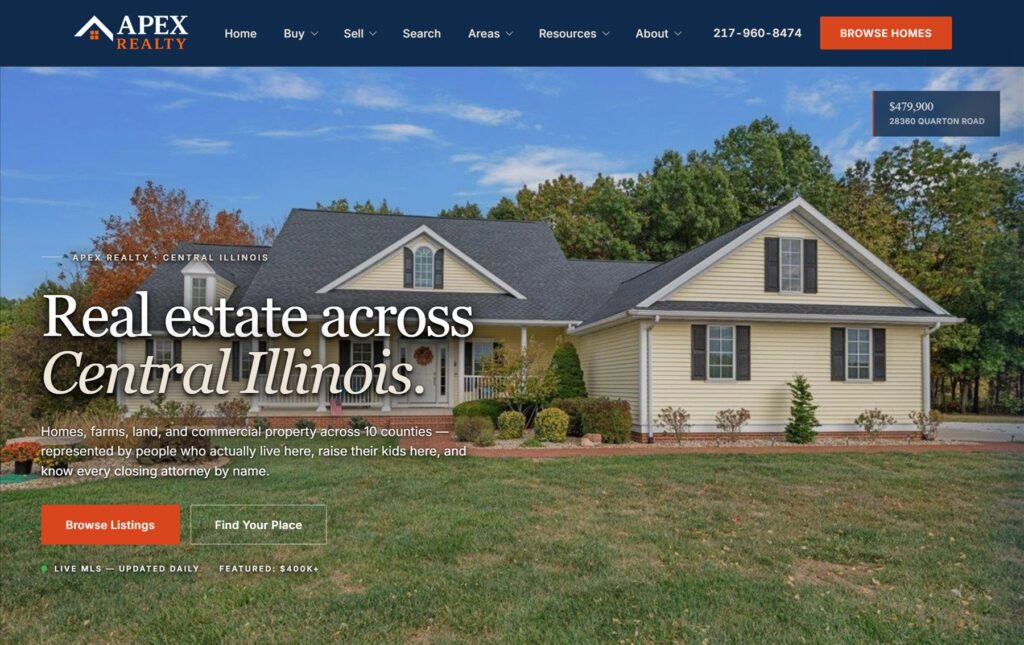
Most real estate agent websites are a template with a logo dropped on top, a contact form nobody fills out, and an MLS search bolted on as an afterthought. They look fine, and they do almost nothing to win listings or rank on Google. When Apex Realty in Jacksonville, Illinois came to Elevated Ideas for a new site, the brief was the opposite: build a custom real estate website that integrates deeply with the MLS, ranks across ten Central Illinois counties, and actually matches how real buyers and sellers search. Here’s how we approached web design for real estate agents, and what the finished build looks like.
The Problem With Most Realtor Websites
Apex Realty is a sharp, growing brokerage, founded in 2014, with a three-broker team covering residential, farm, land and commercial property across Central Illinois. Their old site didn’t reflect any of that. Like most websites for real estate agents, it had the usual problems: a generic template, listings that lived on a separate, disconnected platform, stock photography instead of real homes, and almost no pages that could actually rank in local search. Buyers couldn’t find homes the way they search for them, and Google had almost nothing to index.
We rebuilt it from the ground up as a custom WordPress website designed around three ideas: integrate the MLS so deeply it feels native, build real local SEO into every page, and structure the whole site around how people actually search for homes.
Deep MLS Integration, Not a Bolted-On Search Box
This is where most real estate website design falls short. A typical agent site links out to a clunky third-party search and calls it a day. On the Apex site, the MLS is woven into the entire experience through a full IDX integration. Buyers can search every active listing across all ten counties, filter by price, type, location and features, and view full property details, without ever feeling like they left the site.
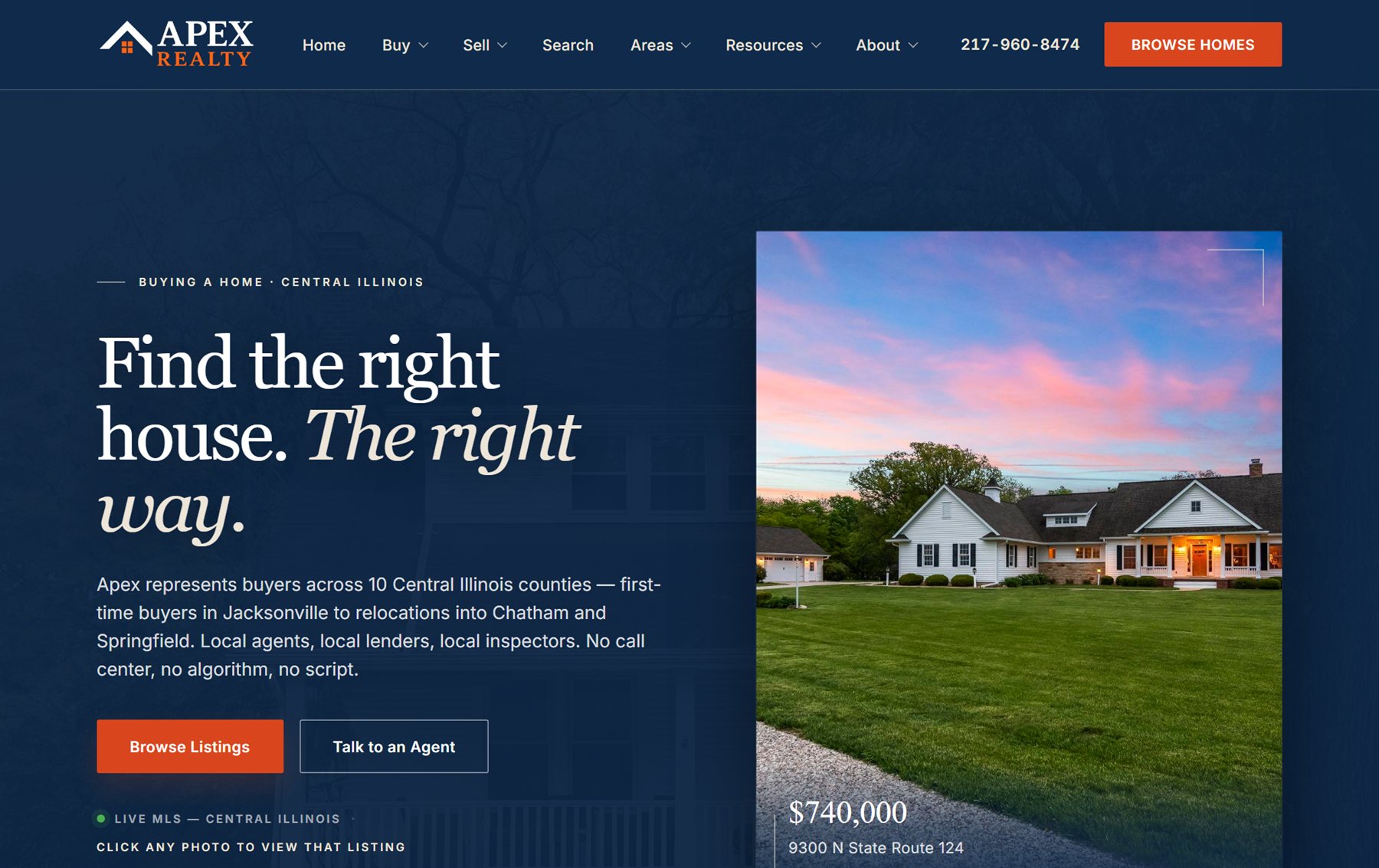
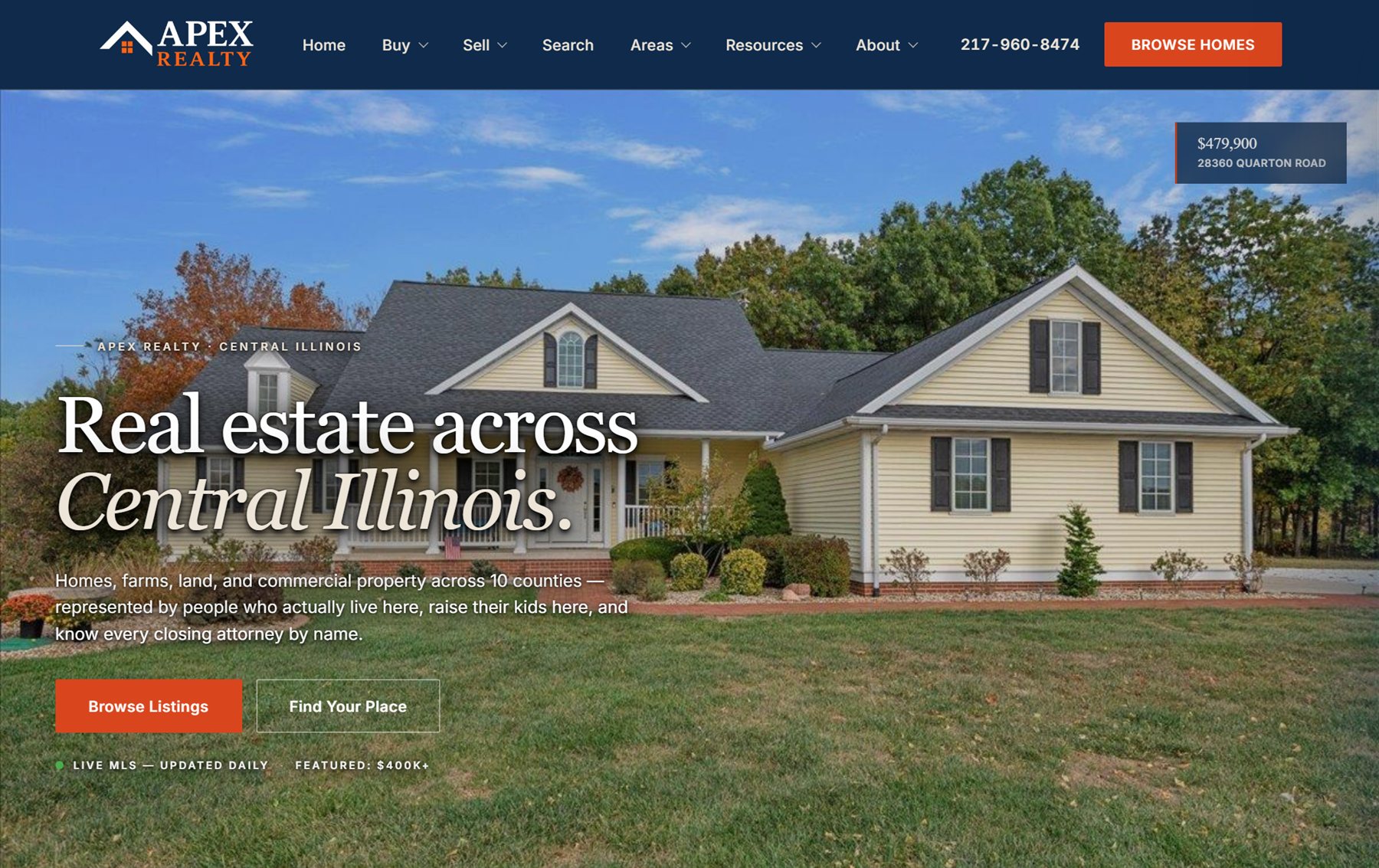
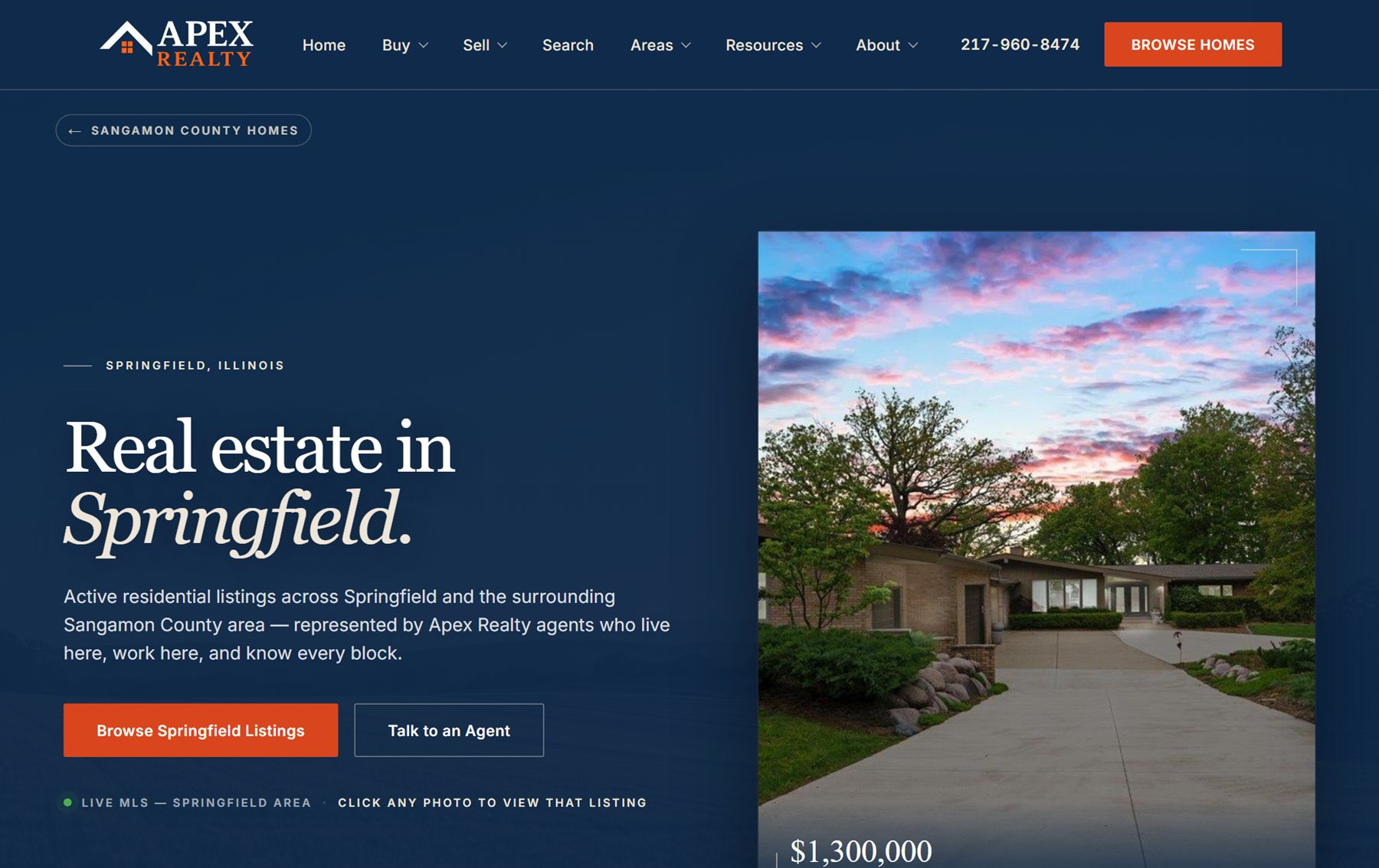
But the part we’re proudest of is more subtle: the photos on the site are alive. The hero image on the homepage, the featured property on the Buy page, and the listings showcased on every city and county page all pull live from the MLS. When a new home hits the market, when a price drops, when a listing sells, the website updates itself automatically. There are no stock photos and no manual updates. Every face of the site is showing real, current inventory at all times, which keeps it fresh for both buyers and Google.
What “live MLS” actually means on this site:
- Hero & section photos pull from the MLS: the big images you see are real for-sale homes, refreshed automatically.
- Every page can feature its own listings: a Springfield page shows Springfield homes; a county page shows that county’s inventory.
- Click any photo, see that property: the imagery isn’t decoration, it’s a doorway into the live search.
- Always current: new listings, price changes and solds flow in on their own, with no one touching the site.
Built Around What People Actually Search For
Here’s the insight that shaped the whole site: people don’t search for homes the way most real estate websites are organized. They don’t type “residential listings.” They search for a town, a neighborhood, and, constantly, a school district. Families pick the district first and the house second. Yet almost no brokerage website has a page built for that search.
So we built them. The Apex site has dedicated, indexable pages for individual school districts, each one wired to the live MLS so a buyer searching “homes in the Rochester school district” lands on a real page with district context, stats, and every active home for sale inside that district’s boundaries.
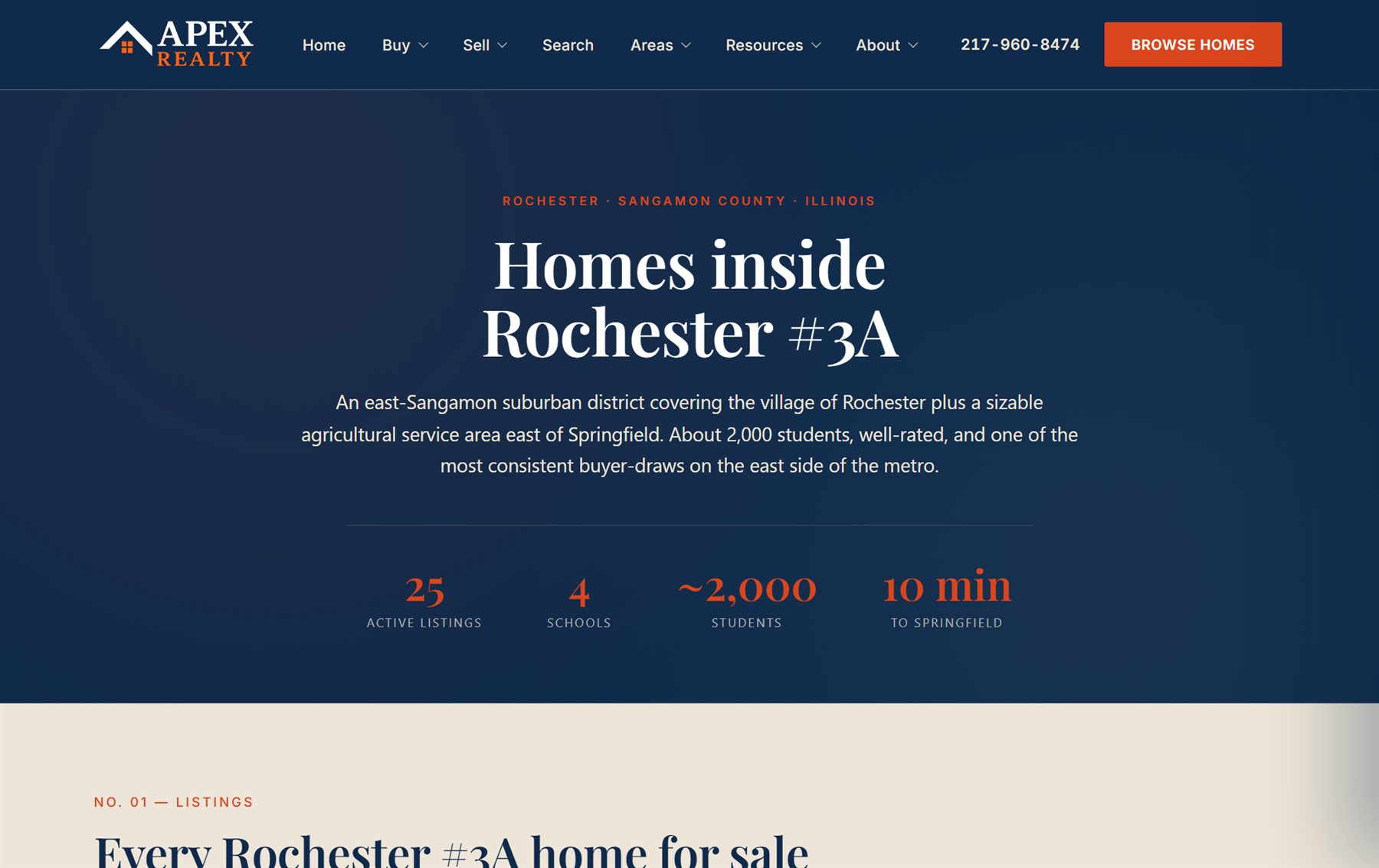
This is the difference between a website that exists and a website that works. It delivers exactly what the searcher wants, the moment they want it. And because those pages target the long-tail searches the big portals ignore, they’re some of the most rankable, highest-intent pages on the entire site.
People don’t shop for “listings.” They shop for a town, a neighborhood, and a school district. The website should be built the way buyers actually think.
Hyperlocal SEO on Every Page
To rank in real estate, you can’t just have a homepage. You need depth. The Apex site launched with roughly 110 pages: a hub for each of the ten counties, individual pages for dozens of cities and towns, neighborhood guides, and the school-district pages above. Crucially, none of it is copy-paste “name-swap” content (the kind Google penalizes at scale). Each city and area page has genuinely local detail (neighborhoods, market notes, landmarks) paired with that area’s live listings.
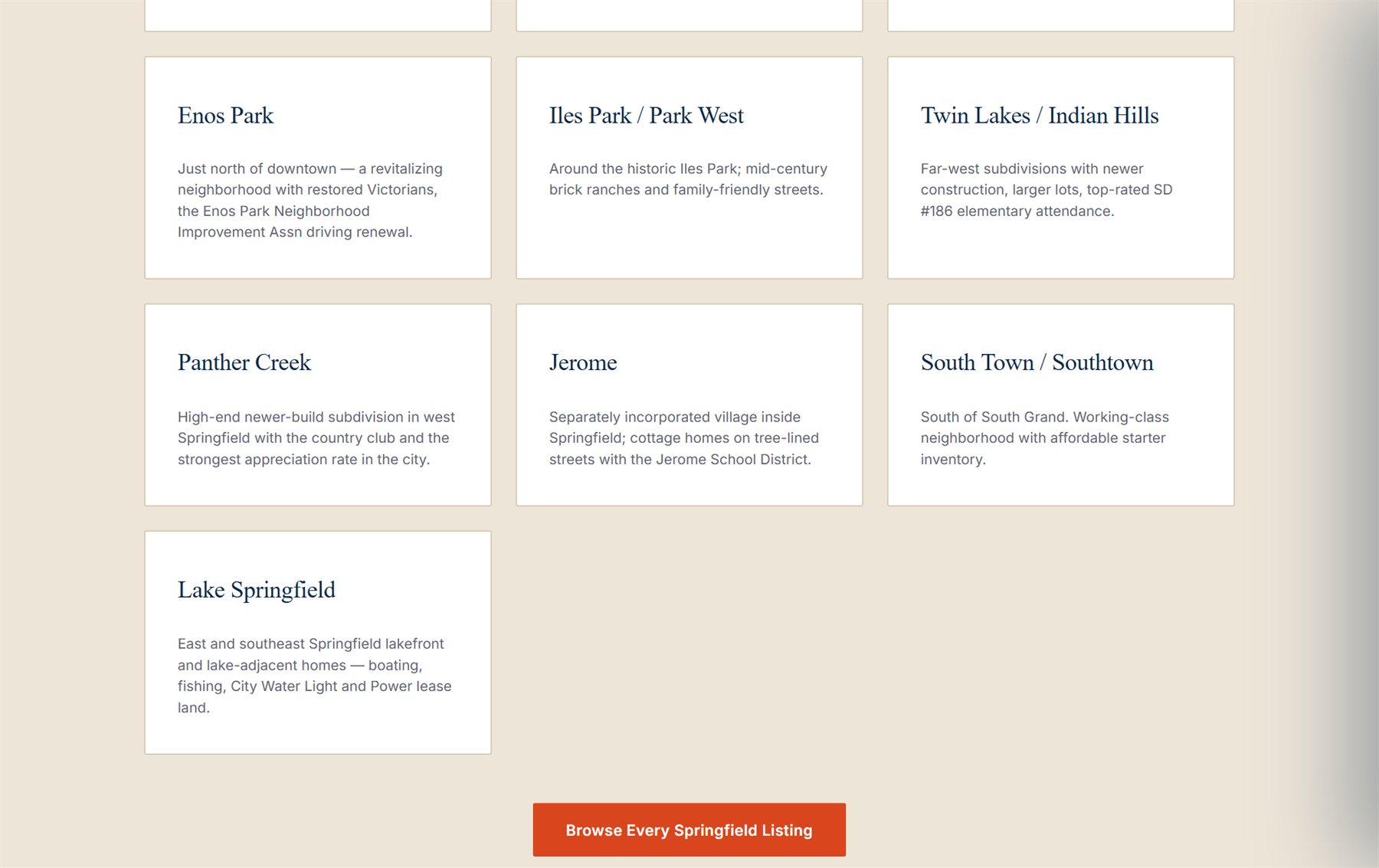
Under the hood, every page carries the right structured data (RealEstateAgent, LocalBusiness, FAQ and breadcrumb schema) so search engines understand exactly what each page is and can show rich results. Fast load times, clean mobile design and a logical internal-linking structure tie it all together. This is what web design for real estate agents looks like when SEO is built in from the first wireframe instead of sprinkled on at the end.
Agent Pages That Build Trust
Real estate is a relationship business, so each agent got a real bio page: professional headshot, specialties, license number, direct contact, and individual Person schema so they can surface in search on their own name. It positions each broker as a credible local expert instead of a name in a list.

Turning Visitors Into Leads
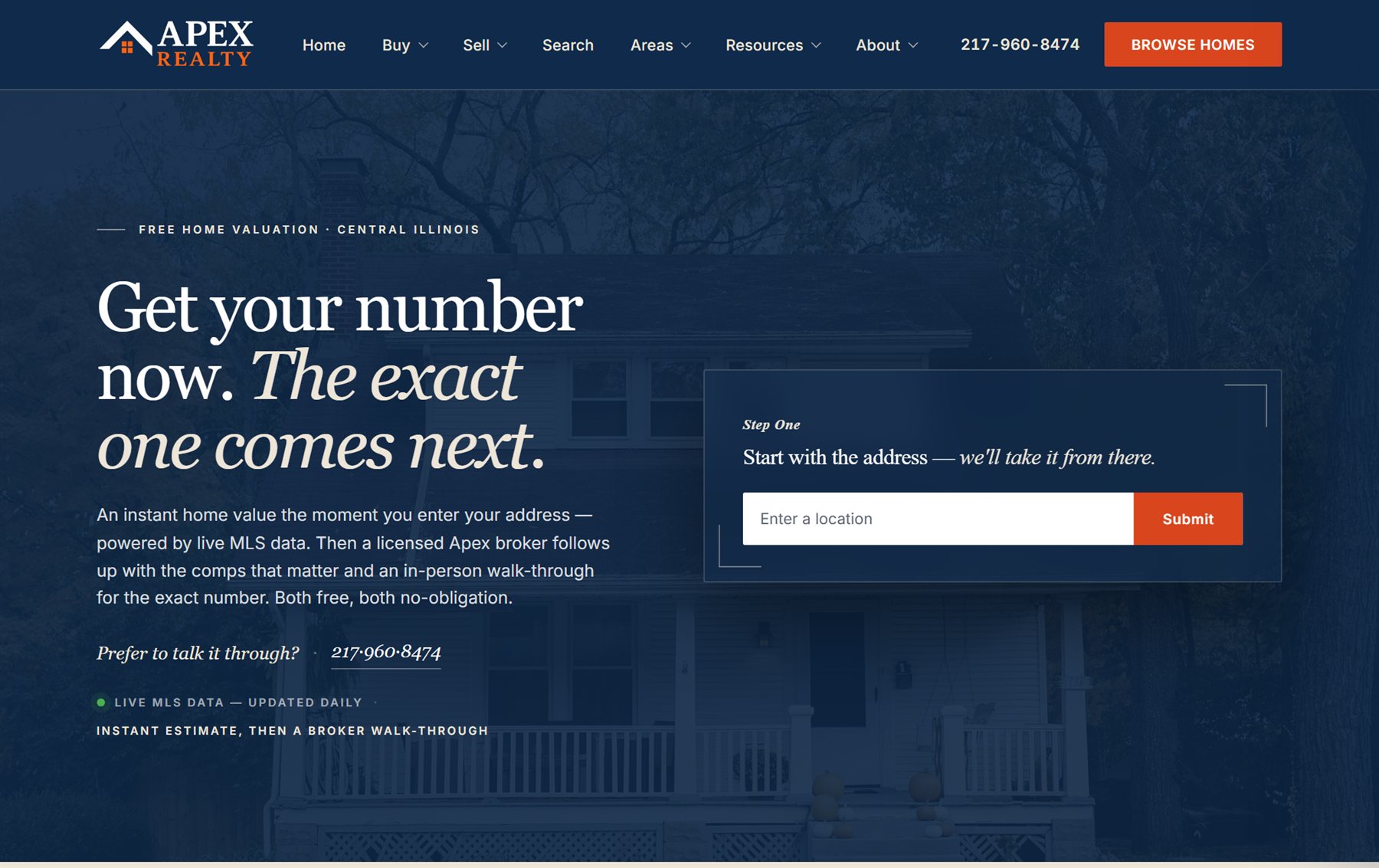
A beautiful website that doesn’t capture leads is a brochure. The Apex site is built to convert. The standout is an instant home-valuation tool: a seller enters their address, gets an immediate ballpark value from live data, and a licensed broker follows up with the real number. It’s the perfect hook for the high-value “what’s my home worth” searcher, and it feeds straight into the brokerage’s follow-up system.
Throughout the site, smart contact forms and clear calls-to-action make it effortless to reach an agent, with every inquiry routed and tracked so no lead falls through the cracks.
The Result: A Real Estate Website That Works
Apex Realty launched on apexillinois.com with a fast, modern, fully custom website: deep MLS integration, live-updating photography, ~110 locally optimized pages, school-district search, agent pages and lead-capture tools, all indexed and built to grow. It’s the difference between a site that simply exists online and one engineered to win listings and rank in local search.
What went into the Apex Realty build:
- Custom WordPress design: on-brand, fast and mobile-first.
- Full IDX/MLS integration with live-updating hero and listing photos.
- ~110 SEO pages across 10 counties: cities, neighborhoods and school districts.
- Search-by-school-district pages built around how families actually shop.
- Agent bio pages with individual schema and direct contact.
- Instant home-valuation tool and conversion-focused lead capture.
- Structured data sitewide: RealEstateAgent, LocalBusiness, FAQ, breadcrumbs.
The Numbers
This is what Apex Realty’s Google Business Profile has done in 2026 so far, measured by Google itself.
Put plainly: between January and July 2026, Apex Realty’s Google Business Profile sent 543 clicks to the website and produced 428 requests for directions to the office, according to Google’s own performance reporting for the listing.
Source: Google Business Profile performance data, January 1 to July 31, 2026. Metrics count actions taken directly on the listing in Google Search and Maps.
Need a Real Estate Website That Actually Performs?
Whether you’re a solo agent or a growing brokerage, Elevated Ideas builds custom real estate websites with deep MLS integration, local SEO and lead capture built in: sites designed to win listings, not just look nice.
Custom WordPress design • IDX/MLS integration • Local SEO built in • Central Illinois
Good To Know
Real Estate Website Design FAQs
How much does a real estate website cost?
It depends on scope. A single-agent site is very different from a multi-county brokerage build with IDX integration and 100+ SEO pages. Because real estate clients are high-value, a well-built site that integrates the MLS and ranks locally pays for itself quickly. Contact Elevated Ideas for a custom quote based on your market and goals.
Can you integrate IDX or MLS listings into my website?
Yes. Deep MLS integration is the core of what we do for real estate agents. We can wire live listings into your search, your city and county pages, and even your hero and section photos so the site updates itself automatically as listings change. Buyers search and view properties without ever feeling like they left your site.
Will a new website actually help me rank on Google?
It can, when SEO is built in from the start. For real estate that means depth (locally written pages for the cities, neighborhoods and school districts you serve) plus proper schema, fast load times and a clean structure. That is exactly how we approached the Apex Realty build, which launched with roughly 110 optimized pages.
Why build pages for individual school districts?
Because that is how families search for homes. Buyers pick the school district first and the house second, yet almost no brokerage site has a page for it. Dedicated, MLS-connected school-district pages capture that high-intent, long-tail search the big portals ignore, and give buyers exactly what they are looking for.
Do you only build real estate websites in Illinois?
No. We are based in Central Illinois and know the local market well, but we build custom websites for real estate agents and brokerages anywhere. The same playbook (MLS integration, local SEO and lead capture) works in any market.
What platform do you build on?
We build custom websites on WordPress, which gives real estate agents full ownership, flexibility and the SEO control that ranking locally requires, without the limitations of a closed template builder.
How much traffic does Apex Realty get from their Google Business Profile?
Google Business Profile performance data shows 543 website clicks and 428 direction requests from the listing between January and July 2026, 991 total profile interactions.